Help us help you. By posting the year, make, model and engine near the beginning of your help request, followed by the symptoms (no start, high idle, misfire etc.) Along with any prevalent Diagnostic Trouble Codes, aka DTCs, other forum members will be able to help you get to a solution more quickly and easily!
I've got a 2004 chevy classic with an interesting problem. When I go to put it in drive I can feel the transmission shifting like normal and it even "tries to move" when I apply the gas but it doesn't actually move. It feels like the parking brake is stuck on. The light isn't on though. I engaged and disengaged the parking brake several times thinking it may have been stuck but that didn't seem to help. When I put it in neutral it won't roll either. What do you guys think?
If it has rear drums then e brake is to tight other wise if truck sat for a while drum is seized to brake shoes. If it is rear disc the e brake arm is stuck from corrosion.
As suggested, safely jack up the wheels and see who doesn't spin.
Keep in mind that if you're checking the fronts, and the transmission is in Park, neither wheel will spin due to the parking pawl. Put it in neutral if it's safe to do so.
I jacked the back up and both wheels spin freely (maybe too freely I think the drums need adjusted).
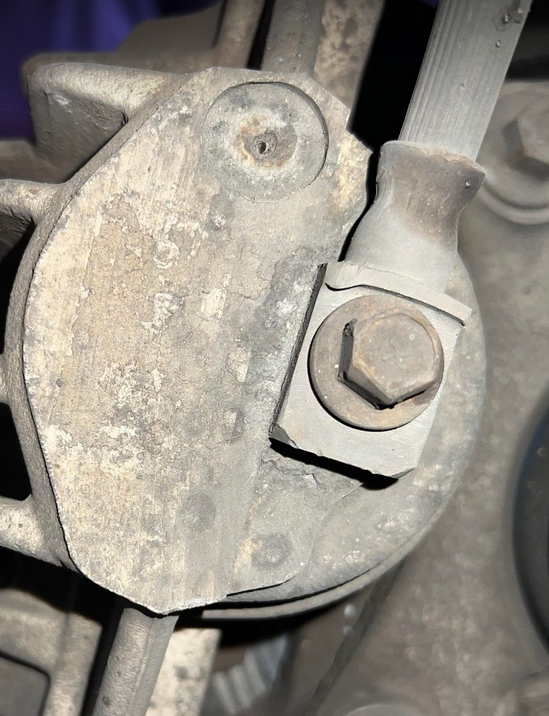
I put the parking brake on then jacked up the front passenger side after of course putting it in neutral and I noticed the hub wants to budge if I move it with my hand but the rotor isn't going anywhere. The caliper is stuck/seized isn't it? How do I approach this?
Take tire off unbolt caliper and use c clamp or welding vise grips and try to compress piston into caliper. (Make sure to remove the brake master cylinder cap as it will make it easier to compress caliper piston) Then remove caliper (you might need to use a prybar to pop it free) once it's off remove brake caliper bracket bolts and remove bracket. Check to see if slide pins are stuck in bores if they are you should be able to use a crescent wrench and work it back and forth while soaking it in pb blaster and pry it outwards to ease the pin out of bore. You can use a rifle bore brush or oil gallery brushes to clean the bores out with brake clean. Then take a drill bit the same size as bore and run it in and out with a drill. Other wise you can get a bracket and caliper assembly from the parts store to replace it. Now with the caliper if it compressed ok and the slide pins were the only thing sticking just replace the bracket. If you had to use significant effort to get it compressed enough to get off then replace both.
Now if caliper pins and caliper compress fine double check that it is in neutral. Also have other side off the ground. Also try spinning other side to see if it spins. Depending on the transmission you have the sun gear pins or something else separated binding trans up there are some tsb's on this issue which if you look at passenger side where the CV shaft comes out of trans the sun gear in question is inside the tail shaft of trans which that end is held on by 4 bolts and an easy tell is removing the output speed sensor from tailshaft housing. And look inside as well as on the sensor for metal sticking to it.
Have you opened the bleeder? That is the first thing I would do. A collapsed brake hose will trap hydraulic pressure in the caliper. If you open the bleeder, and the pressure bleeds off, you have a bad hose.
"Knowledge is a weapon. Arm yourself, well, before going to do battle."
"Understanding a question is half an answer." I have learned more by being wrong, than I have by being right.
Last edit: 4 years 8 months ago by Chad.
The following user(s) said Thank You: juergen.scholl
At this point you can loosen the brake hose itself where it mounts to the caliper to release the pressure. Later you also can purge the caliper there if needed.
An expert is someone who knows each time more on each time less, until he finally knows absolutely everything about absolutely nothing.
When faced with a frozen caliper, I don't play around with them. Too many have come back smoking after freeing them up.(I'm not talking about just frozen slide pins) Now anything with a locked up wheel gets a caliper assembly and rubber hose and I don't have any more come backs.
And if I was on the fence, the broken bleeder is the final nail in the coffin for that caliper in my opinion.
The following user(s) said Thank You: Tyler, juergen.scholl
Thanks for the suggestions guys, bought some calipers, pads and hoses and will be putting them in when I get a chance. Also gonna do a flush and adjust the drums.
Might as well flush the brakes since you're going to do it halfway. You mentioned something about being a daily driver for work or something so a little tlc goes a long way.
Make sure the fluid is clear, bubble free. If you've never bled before then watch a few YouTube videos and you'll be set. Years ago back in the beginning if I was bleeding the brakes I'd have a assistant help so we wouldn't have any issues of air getting in. I eventually moved up to a Pressure bleeder but those are generally for if you do brake bleeding regularly, work in a shop, do your own independent work, etc.

 Topic Author


 Put it in neutral if it's safe to do so.